In Colombia, the restaurant industry represents 3.9% of the gross domestic product in the country. Treinta aims to help restaurants thrive with digital tools that improve their day-to-day operations.
Client
GlobalFinance Inc.
Services
Visual Design
UI & UX Design
Industries
Travel
Date
January 2023
Problem statement
Month by month we lost more than 60% of paid users because our product did not solve all the needs they had.
🥺 Low management efficiency
Owners didn't have enough tools to take decisions and improve the operation.
😫 Complex order creation
The system didn’t help waiters to solve everyday situations.
😳 Software isn't enough
Hardware was a must, and we had to make it works easy with the software.
Restaurants are complex businesses, we have to benefit the entire ecosystem, but to solve this business problem, we start with two principal users:
Andrés Torres
Andrés has two restaurants in Bogotá, so he has to divide his time during the week between the two businesses. He live with his children and wis wife. He also like to play padel with his friends and going to the gym.
Age
35 years old
Education
College degree
Hometown
Bogotá - Colombia
Occupation
Restaurants entrepeneur
Goals
Open more restaurants in the city with a delightful experience.
Frustrations
Most of the time, his restaurants works better when he is there.
Gabriela study art in the morning and start working as waiter on the restaurant at 2:00 pm until 10:00 pm. She like a lot all about art, she like to hangout with her friends to museums, theaters and art events.
Age
23 years old
Education
High school degree
Hometown
Bogotá - Colombia
Occupation
Waiter and art student.
Goals
Live from art, be independent and have time to spend time with my family and friends. Travel the world.
Frustrations
Doesn’t have enough time because of her work and college.
Let's go deep on the problem and how we solve these for our users
🥱 Difficult activation process
Andrés paid the first month but did not use Treinta, so he never learned the value of digitizing his business and he lost money. We are interested in him using us because that impacts retention.
Menu
User just need one thing to start selling on Treinta: Creating his food plates but we see that these process was too long and take a lot of time to him.
We ask fewer things to create a dish and users can also do it in bulk with Excel.
😐 Low management efficiency:
Andrés was still taking decisions with intuition and excel: Month by month, he need to take decisions about the menu, marketing strategies, staff productivity and that stuff that make his restaurant profitable and he didn’t has a tool on Treinta that help him with that.
Statistics
We created a section where the user can check the days with the most sales, their list of products organized from most to least sold, their expenses organized by category and the efficiency of each employee. Best thing about it is that user can view statistics on his phone too.
Inventory is one of the highest expenses in a restaurant, month after month they lose money because they do not keep control of their inventory, some products are damaged and they do not know the real cost of their dishes.
An easier way to record inventory
Before we asked users the cost per unit of each of their products so users had to do some calculates based on the last order they did and it taked a lot of time for them. Now, we ask them how much they bought in their last order and what the value of that order was, thus we help them calculate the cost per unit.
Recipes
Then, when users create a recipe, they add the amount each dish contains, for example: 100 grams. We already know the cost per kilo (Because they told us in the creation of the inventory) so we help users to calculate the cost of those 100 grams and at the end they have a real cost of the total raw materials used in that dish.
😫 Complex order creation
Sara has to deal every day with tables with several diners, different requirements, many payment methods, etc. She needs a tool that helps her optimize the operation and reduce errors as much as possible because each mismatch is deducted from her salary.
Modifiers
It is common that when we go to a restaurant, we want to make modifications to the dish. Treinta did not have this option, which meant that Sara had to write in comments and worse still, this affected the stock. For example, if a user ordered “No cheese,” it was deducted from the recipe but had not actually been spent. So, we create a feature that allow users to add toppings or delete recipe ingredients
Split payments
It is common for large tables to split payments or even for the same customer to pay part of it in cash and the rest with another payment method. By not having this functionality, our users had imbalances in their accounts. Now our users can add different payment methods to the same order.
It is common for large tables to split payments or even for the same customer to pay part of it in cash and the rest with another payment method. By not having this feature, our users had imbalances in their accounts. Now our users can add different payment methods to the same order.
😳 Software isn't enough
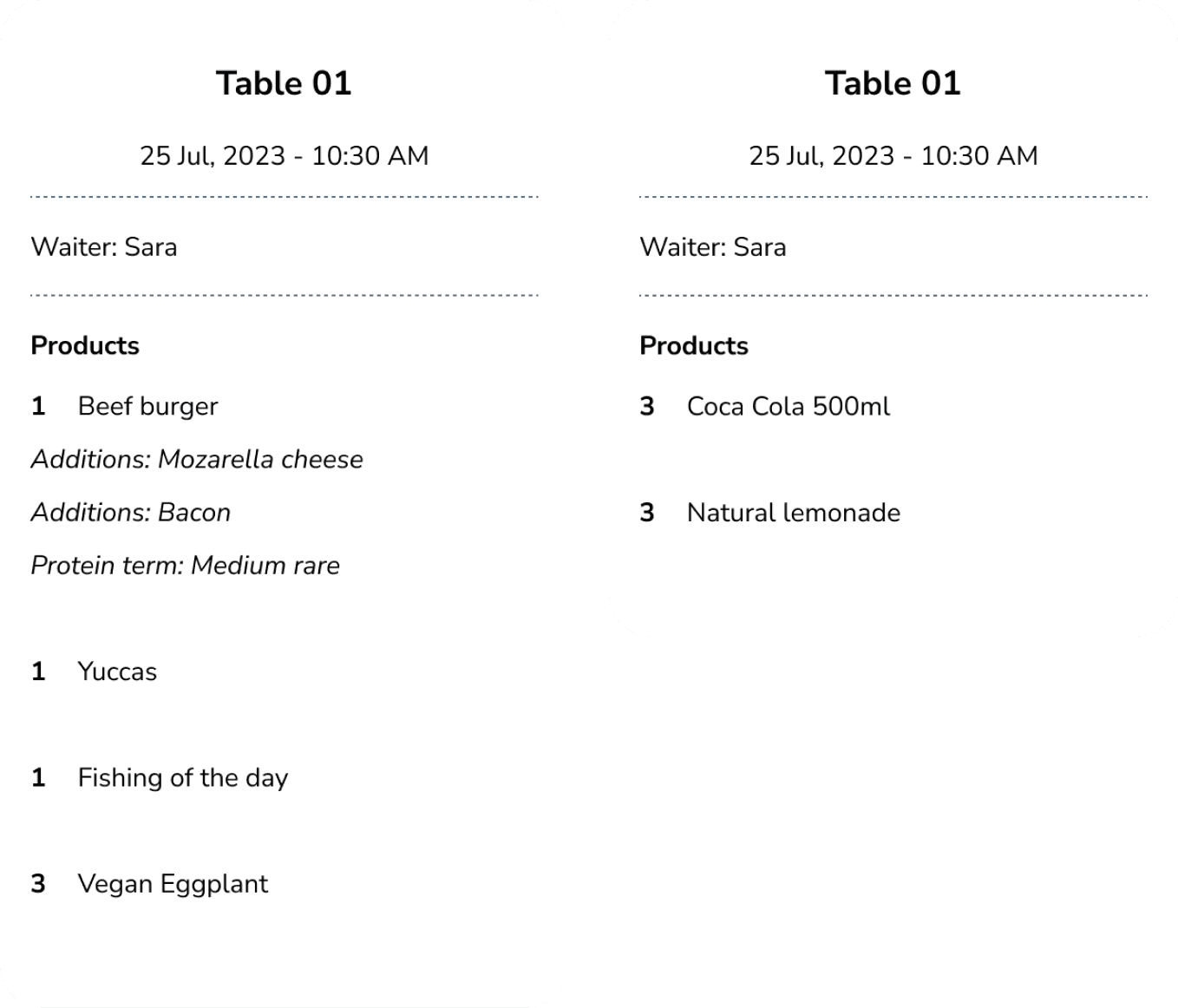
When we began to expand to larger restaurants, we realized that sometimes restaurants handle orders from the bar and orders from the kitchen. We only had the option of 1 printer for orders, which made the operation inefficient.
Orders by zones
Our users can have printers associated with different types of products and each time a sale is made the order will be printed on the assigned printer.
So… what was the impact? 👀
Retention increased 35% on paid users
Activation increased on 43%
Paid users increased 4x
The median number of Transactions created grew by 33%
The median number of food dishes created grew by 80%
The number of users with more than 20 ingredients grew by 71%.